Xinhua
22 May 2026, 20:46 GMT+10
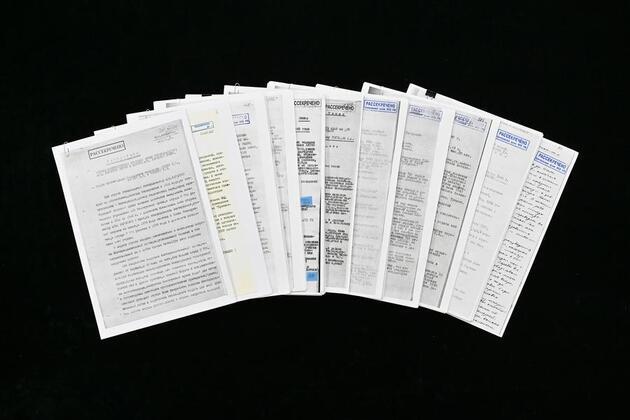
HARBIN, May 22 (Xinhua) -- Chinese researchers recently reviewed the archives of the Khabarovsk Trial declassified by Russia, and released findings on the confession process of war criminals from the infamous Unit 731, a Japanese germ-warfare unit that operated during World War II.
According to Gong Wenjing, director of the international research center for Unit 731 issues at the Harbin Academy of Social Sciences in northeast China's Heilongjiang Province, the Khabarovsk Trial was a public trial conducted by the Soviet Union in December 1949 on Japan's germ-warfare crimes.
On Dec. 13 last year, the National Archives Administration of China published a batch of declassified Russian-provided archives on Soviet interrogations of the Japanese Unit 731 in Khabarovsk. The archives include trial records of Unit 731 members, investigation reports on the unit's crimes, and internal official correspondence of Soviet authorities, covering the period running from May 11, 1939 to Dec. 25, 1950.
"In contrast to the eight previously released interrogation files of Otozo Yamada, last commander-in-chief of the Japanese Kwantung Army, the relevant files have now grown to 18, offering more substantial content and details," Gong said.
The director added that earlier studies of the Khabarovsk Trial mainly drew from the 1950 book "Materials on the Trial of Former Servicemen of the Japanese Army Charged with Manufacturing and Employing Bacteriological Weapons," which largely contained selected excerpts from the trial.
The newly interpreted evidence addresses significant omissions but also reveals that the war criminals' confession process was marked by psychological resistance and evidentiary confrontations, Gong noted.
According to the research, Yamada, a central figure among the war criminals in the Khabarovsk Trial, experienced several dramatic shifts in attitude during nine key interrogations from 1947 to 1949.
In February 1947, he would only concede that Unit 731 served epidemic prevention and water supply. By March 1949, he had partially admitted that the unit secretly developed germ weapons, yet he deliberately withheld his knowledge of crimes including human experimentation and an internal prison.
It was not until December 1949 that Yamada finally confessed to leading both Unit 731 and Unit 100 in developing germ weapons and conducting human experimentation, and accepted full responsibility for his crimes, the research said.
Historical records show that after Yamada confessed, he claimed that human experimentation carried out to verify the effectiveness of germ weapons did not constitute crimes against humanity, arguing that "the law did not explicitly forbid" such acts.
Gong said that Japan, as a signatory to the 1925 Geneva Protocol, was fully aware of the prohibition on germ warfare. She argued that Yamada's excuse was a deliberate attempt to evade criminal responsibility, and that this very fact demonstrates that the Khabarovsk Trial fully protected the defendant's right to defense rather than imposing a one-sided conviction.
She also noted that the ongoing release of the Khabarovsk Trial archives will become a powerful tool for revealing the atrocities committed by the Japanese aggressors in China.
"As a legal proceeding specifically targeting germ-warfare crimes, the gravity and fairness of the Khabarovsk Trial are beyond doubt. Any attempt to twist history will eventually be crushed by solid evidence," Gong said.
"All countries have the responsibility and obligation to urge Japan to thoroughly eliminate the remnants of militarism, so that such tragedies are never repeated," said Chinese foreign ministry spokesperson Guo Jiakun at the end of last year, after China received the Russian-provided evidence related to Unit 731.
"Together, we must safeguard the outcomes of the victory in World War II and the post-war international order, and jointly uphold the hard-won peace and stability in the world," Guo said.
During World War II, the Japanese invading forces established a germ warfare network across multiple Asian countries, with Unit 731 located in Harbin, capital of Heilongjiang Province, serving as a top-secret base for germ weapons and human experimentation.
At least 3,000 people from China, the Soviet Union and other countries and regions were used in human experimentation conducted by Unit 731.
Get a daily dose of St Petersburg Star news through our daily email, its complimentary and keeps you fully up to date with world and business news as well.
Publish news of your business, community or sports group, personnel appointments, major event and more by submitting a news release to St Petersburg Star.
More InformationBEIJING, China: A week after President Xi Jinping hosted Trump in Beijing, China and Russia, at a summit on May 20, condemned U.S....
Hundreds of newly released documents give insight into Cold War-era UFO sightings tracked by military radar systems worldwide ...
HARBIN, May 22 (Xinhua) -- Chinese researchers recently reviewed the archives of the Khabarovsk Trial declassified by Russia, and released...
More than 8,000 Russian civilians have been killed since February 2022, including more than 350 from January through April this year,...
New dates for the gathering, which would be the first in more than a decade, will be announced after consultations over the crisis,...
The recent summit in Beijing confirmed one thing - the unipolar era is over The recent...
GENEVA, Switzerland: The World Health Organization said on May 20 that the Ebola outbreak in eastern Democratic Republic of Congo likely...
NEW YORK CITY, New York: U.S. President Donald Trump disclosed more than 3,600 stock trades during the first quarter of 2026, revealing...
BEIJING, China: A week after President Xi Jinping hosted Trump in Beijing, China and Russia, at a summit on May 20, condemned U.S....
MEXICO CITY, Mexico: Mexico has frozen the bank accounts of some former officials accused by the United States of having links to the...
MALE, Maldives: Italy's Foreign Ministry said this week that rescuers have found the bodies of the four Italian divers who went missing...
LONDON, U.K.: Britain's second most senior diplomat in Washington, James Roscoe, has left his post, the British Foreign Office said...